 Fast Learning Method
Why Learning Spanish in Classroom-Style Settings Fails Most Learners — And Why We Switched to a Simulated Restaurant
Written by Josh Roberts
Estimated read: 7 minutes
At Rapido Spanish, We Agree — You Should Already Be Speaking Spanish
Rapido Spanish was built around the idea that most Spanish learners spend years studying grammar and vocabulary but still struggle to speak fluently in real conversations.
If you’ve been trying to learn Spanish since high school — you should already be speaking it. The problem is not effort. The problem is environment.
How You Learned Your First Language Naturally
You didn’t learn your first language in a classroom. You learned it at home through constant exposure.
You listened first. Then you started speaking. With every conversation, your understanding grew.
School came later to correct grammar — not to create speech.
The Traditional Learning Path
Most learners go through the same system:
- High school Spanish classes
- Flashcards
- Fill-in-the-blank exercises
- Language apps
And still cannot speak fluently in real conversations.
Why Classroom Learning Breaks Speaking Ability
In classrooms, the brain shifts into performance mode. You are being watched, corrected, and graded.
This creates hesitation — and hesitation blocks speaking.
Why Immersive Travel Works (But Is Expensive)
The fastest way people learn Spanish is by going to another country.
In that environment, everything works in your favor — you are surrounded by the language, immersed in the culture, and constantly exposed to real communication. There is natural pressure that pushes you to respond, your brain stays active and engaged, and you have time to adapt and learn through daily experience.
In other words, immersive travel gives you all the winning factors: environment, culture, pressure, immersion, and time. But once you return home, that entire system disappears, and so does most of the progress.
Rapido Spanish is designed to recreate those same conditions without requiring travel. Instead of going abroad, learners join like a gym membership with friends, family, or coworkers and create their own learning team inside a structured environment called Marcos.
This approach keeps the benefits of immersion — environment, pressure, repetition, and real conversation — while adding something travel cannot: consistency. Learners don’t lose the environment when they go home; they stay inside it, building fluency together over time.
We Don’t Rely on Immersion — We Build It
Most programs treat immersion as something you have to travel to. We take a different approach: we create structured environments where Spanish is used in real time through interaction, repetition, and pressure to respond.
Instead of studying the language first, learners use it first. They learn by operating inside the language, not outside of it.
Inside Rapido Spanish: How Marcos Turns 15 Words a Week Into Real Conversations
Rapido Spanish is built on a simple but structured system called Marcos — a controlled learning environment where Spanish is required in order to move forward.
Instead of overwhelming learners with hundreds of words at once, the platform introduces a focused weekly vocabulary set of about 15 words and phrases. These include menu items, request phrases, response phrases, and everyday functional language used in real conversations.
As the week progresses, learners don’t just memorize these words — they use them repeatedly inside simulated real-world scenarios. That repetition builds familiarity, and familiarity turns into fluency over time.
Each new week expands on the last. The vocabulary bank grows gradually, but more importantly, learners learn how to combine what they already know into sentences and responses that feel natural in conversation.
Over time, 15 carefully selected words per week compound into a much larger working vocabulary — not through memorization, but through usage, pressure, and context inside the environment.
The result is a learning loop where words become phrases, phrases become sentences, and sentences become real conversational ability inside the Marcos environment.
Putting Your Spanish to Work
Every week, learners are introduced to about 15 new words and/or phrases. Instead of memorizing them, they immediately begin using them inside the Marcos restaurant simulation.
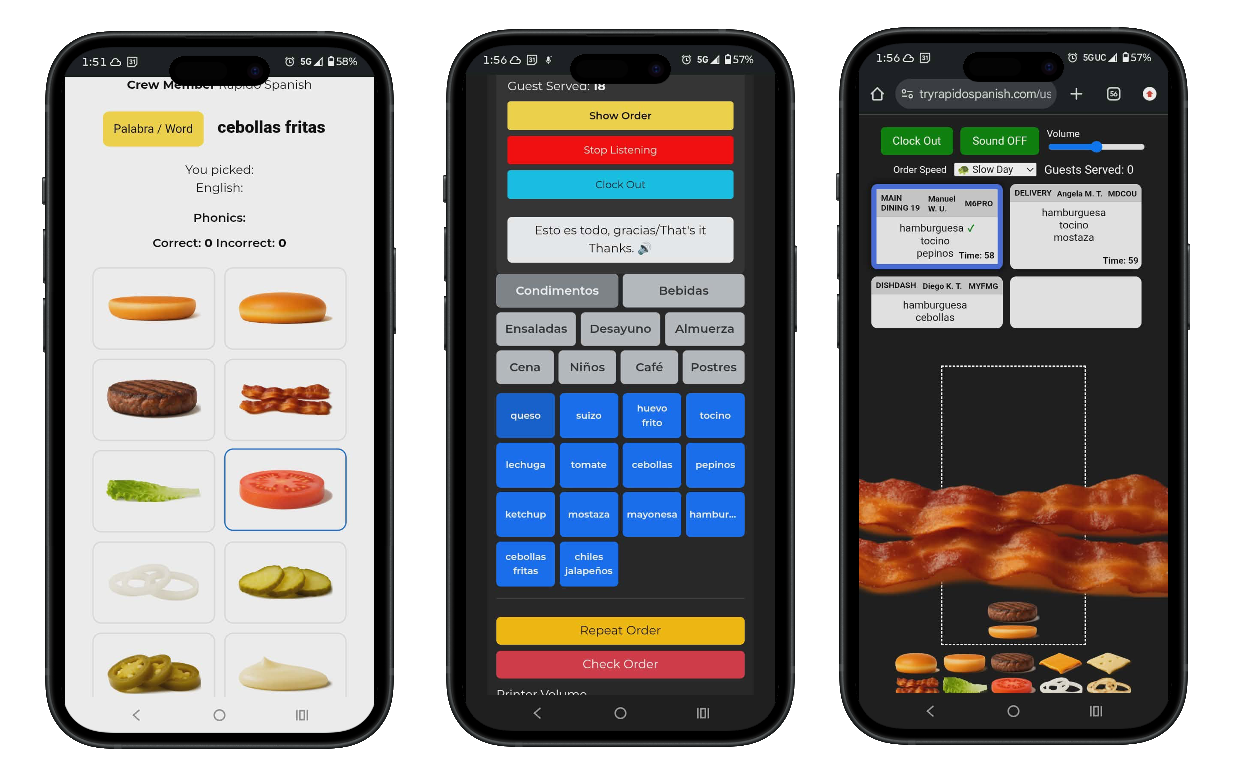
They start at the front register, where they greet customers, listen to orders, take orders, ring up purchases, and answer questions—all in Spanish. If they don't understand something, they use one of the phrases they learned that week, such as:
¿Puede repetir su orden?
Can you repeat your order?
Prompting the simulated customer to repeat their order.
Using phrases like this allows learners to keep the conversation going naturally while building confidence and improving their listening skills.
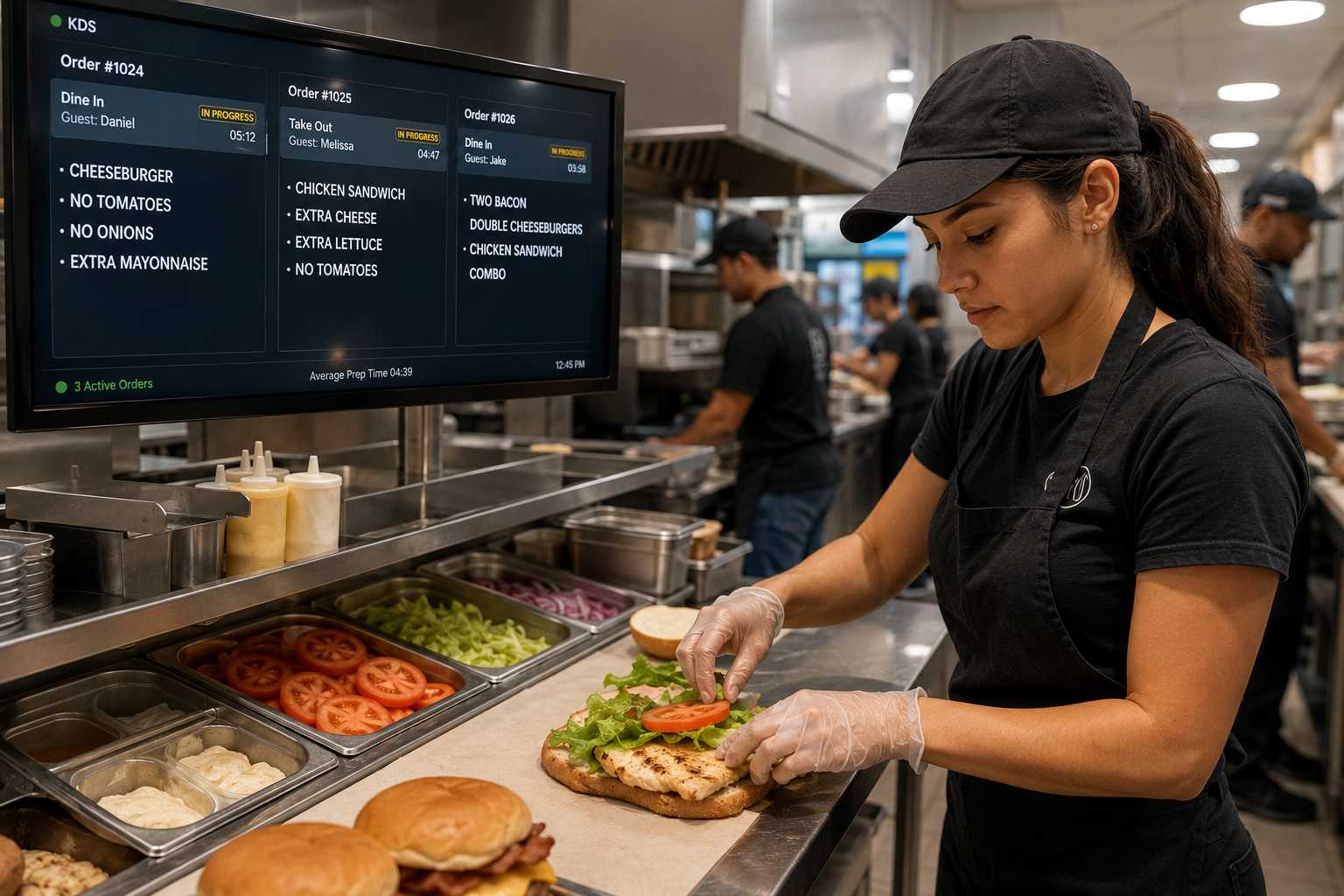
Next, learners move to the Express Sandwich Station. There, they read customer orders from a simulated Kitchen Display System (KDS) and drag and drop the correct menu items onto each ticket.
Timers and color-coded alerts create the pressure of a real restaurant, helping learners think and respond in Spanish instead of translating every word.
By staying focused on serving customers instead of studying grammar, learners naturally build confidence, improve their listening skills, and begin speaking Spanish more automatically.
The First-Day-of-Work Effect
Nobody learns faster than a trainee on their first day of work.
You adapt quickly because you must.
Our System: 240 Core Words That Become Real Conversations
We don’t overwhelm you with vocabulary. We teach 240 core words and phrases that actually get used in real life.
These 240 words are built around real everyday restaurant communication between customers and co-workers:
- Menu items
- Core vocabulary words
- Request phrases
- Response phrases
From there, everything expands.
Words turn into request and response phrases. Request and response phrases turn into full sentences. And those sentences turn into real conversations.
That’s how 240 core words can generate over 10,000 real conversational combinations — not through memorization, but through usage inside real situations.
These expand into thousands of real conversations.
Why This Works
- You hear Spanish before you analyze it
- You speak before you overthink
- You learn through pressure instead of memorization
- You build real conversation patterns
- You develop automatic responses
Try the 7-Day Preview Week
Experience the system instead of studying it.
No credit card required
Final Thought
We agree with you — you should already be speaking Spanish.
The problem was never intelligence or effort. The problem was environment.
So we changed it.